

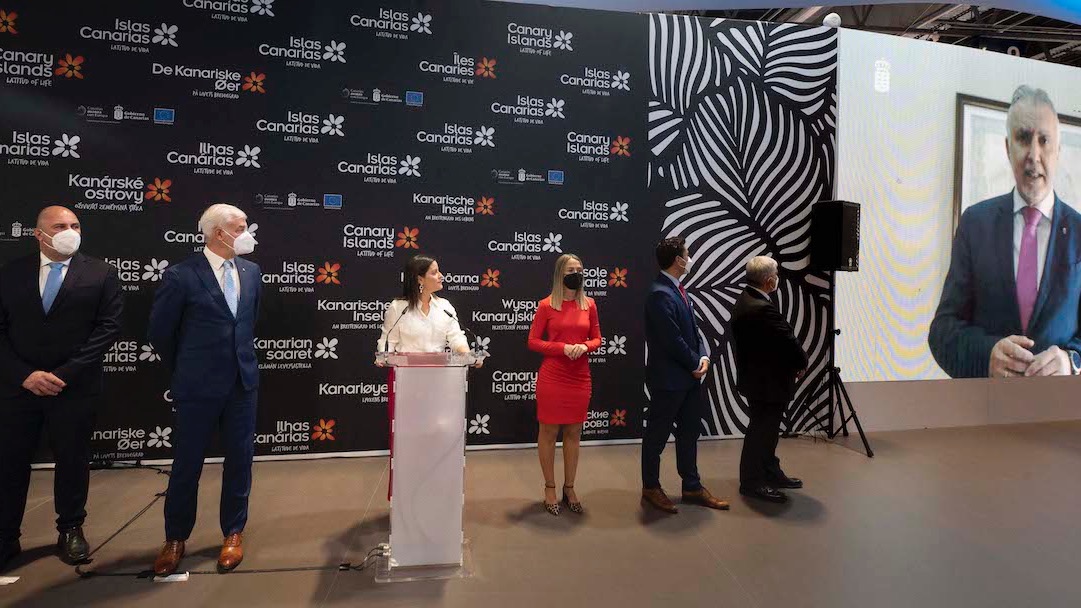
Ángel Víctor Torres inaugurates the islands pavilion in Fitur, where he highlights that last year the archipelago received almost 7 million tourists and generated a turnover of 8.000 million euros and affirms that 2022 will be “the year of recovery”
The Canary Islands begin their journey at the Fitur 2022 International Tourism Fair supported by the recovery of more than 50% of their tourist activity last year and the forecast that in 2022 this will reach 90%. Some positive data that starred in the inauguration of the archipelago's stand at the Ifema fairgrounds, carried out by the President of the Government of the Canary Islands, Ángel Víctor Torres, through a video projected on the big screen, and the Minister of Tourism, Industry and Commerce, Yaiza Castilla.
In his speech, the president highlighted that the Canary Islands “achieved a tourist turnover estimated at 2021 million euros in 8.000, that is, 54% of the figure generated in 2019”, a pre-covid year in which 15.000 million euros were reached.
This was possible, Torres said, thanks to the recovery that began in the second half of the year in which, in the absence of knowing the exact data for December, “2021 would close with a figure close to 7 million national and international tourists.” , noted the president.
Among other indicators, Torres also indicated that the reactivation is being seen in more favorable employment data. “In December 2021 we had a better unemployment rate than we had before the pandemic and that is the way,” she said. For the head of the Canary Islands Executive, “if there are no unforeseen events, and we depend on the evolution of Covid, 2022 will be the year of recovery.”
Ángel Víctor Torres pointed out that for this winter there are 11,3% more places with the peninsula and that "The Canary Islands will welcome with open arms national tourism and British, German, Scandinavian and other visitors who want to visit us."
The president had a special mention of La Palma and the end of the eruption on an island that, along with the entire archipelago, awaits tourists who want to “enjoy our gastronomy, hospitality, our infrastructure, our beauty and our climate.” .
Finally, Torres shared a reflection on the tourism recovery and the transformation of the Canary Islands economy, taking advantage of the extraordinary resources that come from Europe, such as the Next Generation funds, “which are committed to green transformation and more sustainable tourism.” Resources that, in the opinion of the president, “must be well managed so that they reach Canarian society and, also through tourism, more and better opportunities are generated and the transformation of our land occurs,” he concluded.
For her part, counselor Yaiza Castilla emphasized that “despite all the hard moments experienced since the beginning of the pandemic, on the islands we have continued to move forward and I want to believe that this is now unstoppable” and added that different sources and Global indicators repeatedly point to Spain as the third vacation destination in the world, “which undoubtedly benefits the archipelago.”
“Our climate, our heritage and nature offering, our gastronomy and also two elements that have become fundamental aspects for choosing a destination, such as physical and health security, guarantee that we are in those first positions in the vacation aspirations of the world,” Castilla explained.
Castilla spoke of how the Canary Islands have overcome a year that, “despite the fact that in the first half of the year it was almost lost and after a summer with still low international demand, but with the push of domestic and national tourism, it finally closed with the recovery.” of more than 50% of tourist activity.” A positive figure in which peninsular tourism played an important role, which led the recovery since the outbreak of the pandemic, displacing British visitors for the first time and becoming the main issuing market in 2021, with 1.296.265 visitors arriving from the peninsula.
Finally, the counselor highlighted the commitment to sustainability and the decarbonization of tourist activity as a hallmark of the islands and as the elements that must lead the reactivation of tourism.