


We are seeing how the long-awaited summer recovery is once again distorted by factors such as queues at airports (due to the lack of security and ground personnel) and notable inflation in all components of the trip (flight, rental car, restaurants, etc.). And if we dare to look a little further, the forecast can be even more worrying: there is the possibility that some of our source markets, such as Germany, will face gas supply problems in winter. Needless to say, this would harm tourism. But, can Tourism in turn be a help to alleviate this situation of gas shortage? Maybe yes:
"Traveling against Putin is better than freezing because of Putin"
Last May, the Association of Independent Travel Agencies in Germany proposed subsidizing the holidays of retirees who spend their holidays in warm destinations during the winter with 500 euros. This way they would consume less energy during the winter, a time when gas for heating may be scarce as a result of the war in Ukraine. The proposal has not yet received a response from the German Bundestag, but its approval seems difficult.
Although trips are not subsidized, the proposal has launched a unique marketing headline for warm winter destinations, where the Canary Islands have few competitors. It is possible that next winter the Canary Islands will once again become a refuge destination for Germans with long stays to escape the heating costs, which, if the war scenario does not change, are expected to be astronomical. And we don't have to stop just at the seniors. The same behavior could occur in a worker who could relocate from his company for several weeks in winter and work remotely. Be that as it may, the situation requires adapting the offer to the most desired long-stay segments, in the case of the elderly, to become an age-friendly destination. Let's see some keys to this in terms of accommodation and the silver strategy:
Socio-health centers: accommodation model for the age-friendly destination?
No, is not that. It is interesting as a complementary option, but not as the main accommodation model, as a political party from Gran Canaria proposed a few days ago. Let's stop associating the silver segment exclusively with reduced mobility, disability and/or dependency! Certainly, there is a large part of this macro-segment with progressive mobility problems, another with disability and even dependency, but also a large part with excellent health, as the Global Wellness Summit pointed out to us in 2020 in one of its macrotrends: "repositioning of aging: positively active".
A social and health center in the tourist area ("holiday nursing home") can provide coverage to a segment of seniors, but not to the general mass of an age-friendly destination. That is, an age-friendly destination must be designed for all levels of health status of the elderly client: from those who have reduced mobility or significant disabilities to those who enjoy excellent health and are very active.
Therefore, if we consider an age-friendly holiday city , instead of the holiday nursing home as the main accommodation model, we will talk more about the traditional holiday hotel, simply adapted to some of the elderly's service needs (socialization, access to health services, etc.), or other forms of accommodation that are not far removed from the conventional one, such as holiday cohousing, a model that exists in the residential field and that could have good potential in the tourist sector, but which would require clear regulations in holiday rentals (above all, with regard to the rental of individual rooms within a unit).
Silver Strategy
Be that as it may, a hub that aims to welcome a high number of silver tourists and promote long stays as an age-friendly destination needs a comprehensive silver strategy that contains elements for all areas of interest to the elderly: mobility, citizen security , health services, age-friendly policy, accessible public transportation, places for socialization and special activities & programs.
I don't want to end the post without some concrete proposal that goes beyond "let's promote silver tourism." To do this, I have selected 10 outstanding proposals from previous posts on this blog about senior tourists, which should be implemented as soon as possible, already for the 22/23 winter season. The actions could be part of a broader "silver strategy", something that Playa del Inglés should have already defined, and some of which would be susceptible to being financed by EU funds.
10 urgent silver measures for Playa del Inglés
(1) Provide public restrooms: Boasting about "smart destination" projects without providing public restrooms is foolish. Providing public restrooms should be a priority, both in the tourist area and on the beach. This benefits all tourists, but especially silver tourists, for example, who are more vulnerable to walking longer distances.
(2) More benches for resting: It's curious that one section of the seafront promenade, in its first stretch from the Tropical Shopping Centre to the Dunamar Hotel, has a bench approximately every 30 meters (57 in total), while in its second section, from the Sahara Playa Hotel to the RIU Palace, there are only two. Playa del Inglés, in general, has too many long pedestrian stretches without benches.
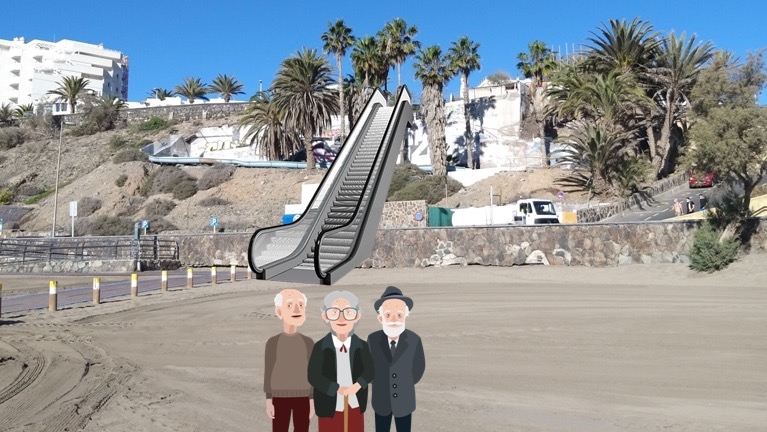
(3) Beach elevators: However active a senior citizen may be, many find the stairs to Playa del Inglés challenging. An age-friendly area must offer alternatives such as an elevator or escalators. The Toboplaya plot, acquired by the City Council at the end of 2020 and which has once again been inhabited by homeless people, could be the ideal location for an escalator to the beach.
(4) Safe walks: In an age-friendly destination, tourists should be able to walk along avenues without tripping hazards, with sufficient lighting at night and defined rules for vehicles (electric skates, bicycles, scooters, etc.) that travel through the elderly person's walking territory: avenues and sidewalks.
(5) Public safety: The elderly are the most vulnerable and, therefore, a favorite target of criminals. They are, for example, one of the groups most affected by the bracelet scam. A senior citizens' center must be able to guarantee the safety of its residents.
(6) Nighttime rest: It is impossible to claim to be an age-friendly destination without controlling the large gatherings of local youth drinking in the streets at any time of night, every day of the week. These gatherings are on the rise in Playa del Inglés and are not limited to summer; they also occur in winter, as they have become a "new lifestyle." Controlling these gatherings may not only involve dispersing and issuing fines, but also considering alternatives for young people, such as building a "leisure area" on the outskirts of Vecindario, away from the main tourist area.
(7) Designation of the nudist area: Senior tourists have always been among the profiles of naturist tourism, which has had its designated area for more than 50 years. In order to prevent nudism, a unique tourism product of Gran Canaria, from continuing to coexist with family tourism, it is advisable to maintain this designated area.
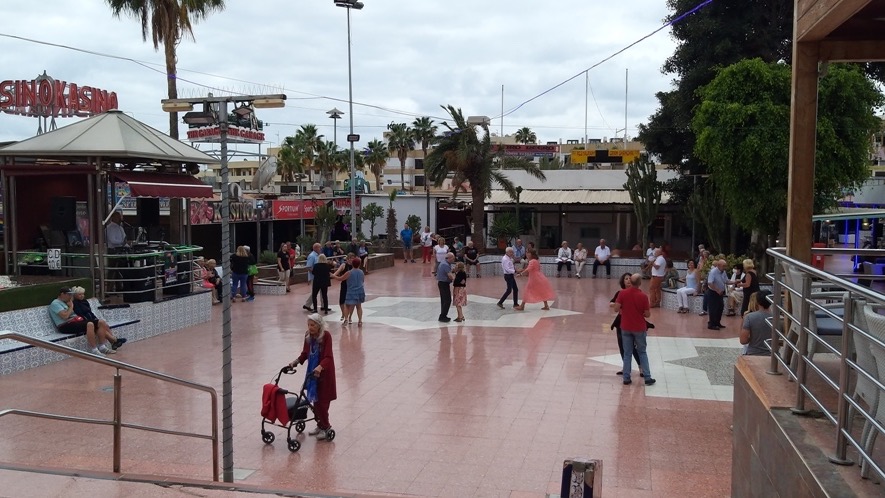
(8) Leisure and social areas for seniors: This is essential! Currently there are very few places for seniors to socialize and those that exist are very improvised, such as dancing at night in the Kasbah square or the "Frühschoppen" on Sunday mornings at the end of Annex II.
(9) Safe streets with appropriate signage: A destination for older people cannot have confusing pedestrian crossings (blurred zebra lines, due to overpainting) or crossings without the required signage. Note that the core lacks traffic lights (there is no longer a "green light" accompanied by an audible alert for the visually impaired), so pedestrian crossings should be carefully designed and adequately lit.
(10) Public transport: English-style taxis . When I propose offering taxis for seniors, I am not referring to taxis adapted for wheelchair users (each municipality has long been required to have more than 5% of its fleet adapted; Royal Decree 1544/2007). I am referring to taxis that facilitate entry and exit for customers with reduced mobility, or for convenience, just as the famous English taxi (TX model) does.
Of the current taxis on the island, the model that most closely resembles it, in height, is the Dacia Lodgy. It is much more comfortable for an adult to get into a Dacia Lodgy than into a Mercedes, for which you have to bend down much more. The difference with the English TX is that it is also more spacious for the legs; In this case, the older one does not need to work as hard to bend his legs to enter. The English taxi can now be purchased in Spain in its new electric version. Without a doubt, the ideal vehicle for an age-friendly destination.

Age-Friendly Destination: A Theme Park for Seniors. Ultimately, an age-friendly tourist hub is nothing more than a giant theme park for seniors , a place tailor-made for their needs and vacation expectations, taking into account the many possibilities of their age-related conditions. It's long been said that Playa del Inglés is an ideal destination for retirees, a "senior city," and it's certainly an attractive and viable specialized option for seniors who want to escape Putin next winter with an extended stay in Gran Canaria. Or to cope with the potential loss of the low-cost segment when airfare prices increase significantly. But to be able to compete, work needs to start now.
Opinion article: Antonio Garzón
https://www.antoniogarzon.com