

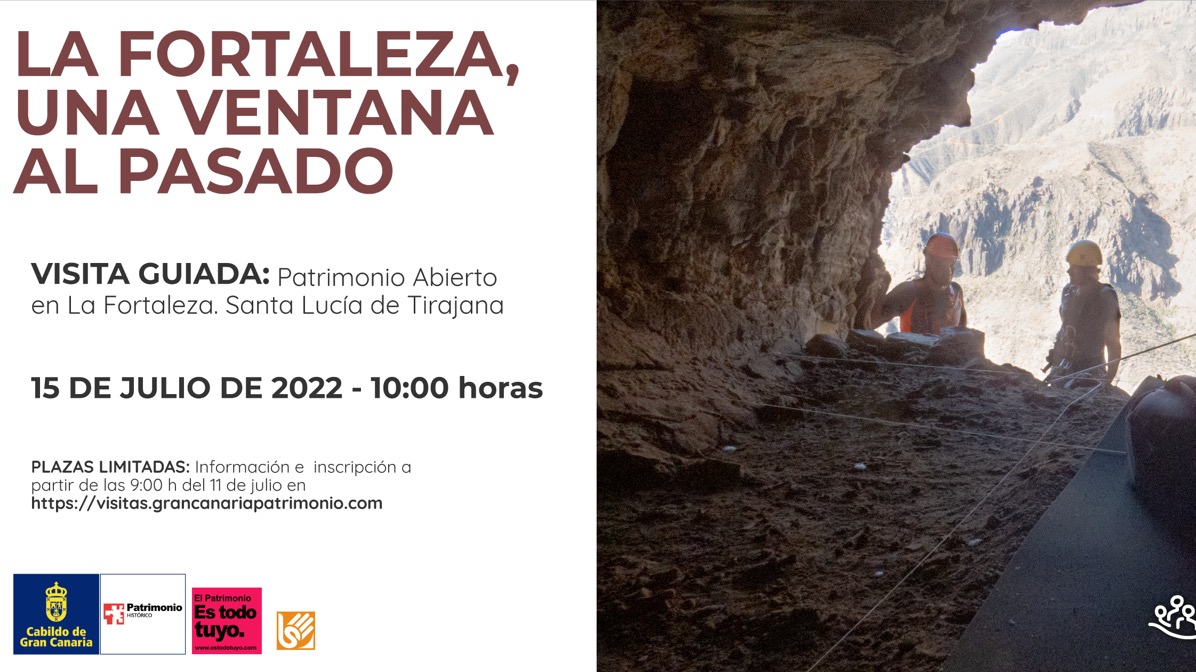
The Cabildo, in collaboration with Tibicena Archeology and Heritage, organizes a guided tour of the archaeological area that will take place this coming Friday, July 15
Information will be offered on the results of the ongoing archaeological interventions and data on the way of life and the way of understanding the death of the ancient populations of the Island.
Those who wish to participate in the activity can now register at https://visitaspatrimonio.grancanaria.com/events/114
The Historical Heritage Service of the Cabildo of Gran Canaria has found vestiges of unprecedented funerary practices of the ancient inhabitants of the southeast of Gran Canaria related to newborns and babies a few months old, during the work carried out in the area archaeological site of La Fortaleza, in Santa Lucía de Tirajana.
Thus, the Service, within the framework of its dissemination activities, in collaboration with Tibicena Archeology and Heritage, has organized a guided tour 'Open Heritage' to this enclave, which will take place next July 15, starting at 10.00:XNUMX hours, and in which the results of the archaeological interventions in progress will be reported, as well as the current knowledge of the ways of life and the way of understanding the death of the ancient island populations.
The complex of La Fortaleza is one of the sites in Gran Canaria that exceeds a thousand years of uninterrupted occupation, from the 3rd-4th centuries AD until practically the moment of the Castilian conquest. In this place, different archaeological manifestations are preserved that inform about the life and death of the group of people who chose this southeastern enclave as their permanent home. The recent archaeological interventions promoted by the Historical Heritage Service of the Ministry of the Presidency open a new window to the past, especially to the funerary practices of this population and the particular treatment that part of the child population was subjected to.
The Government of Gran Canaria has promoted and financed various actions in this archaeological area and, in particular, interventions aimed at increasing the knowledge of the population that occupied this place and the dissemination of the values that this asset of cultural interest treasures.
In this year 2022, the scheduled actions pursued a double purpose. On the one hand, begin the study of the storage areas present in the Fortaleza Grande and, on the other, obtain information about what the funerary practice of the ancient Canarians who lived in this complex in the southeast was like.
While the work on the granaries has only just begun, the archaeological examination of different cave graves has revealed an unprecedented scenario so far for the archeology of Gran Canaria. From the results obtained, it can be said that two of the caves that were excavated were spaces reserved exclusively for the mortuary deposit of young children. Places where, above all, newborns or those who died in the first months of life received burial, which distinguishes them from those nearby enclaves of a collective nature, which would house the rest of the members of the community.
It should be noted that the particular treatment of younger boys and girls in funerary practice is something relatively common in different societies of the past, but until now it had not been documented for the sepulchral caves of Gran Canaria. For now, it is not easy to offer a definitive explanation for this behavior. In other groups, it is suggested that people who died before reaching a certain age, perhaps having died before receiving their social recognition, are not deserving of the same treatment as 'full members' and who make up the category of ancestors. . In any case, and to delve into these issues, the study of the recovered bone materials still needs to be carried out, in order to precisely determine the age of death and, if possible, estimate its sex, as well as send samples. for the determination of its age by carbon 14.
Those who wish to participate in the guided tour of the La Fortaleza site must register in advance through the website https://visitaspatrimonio.grancanaria.com/events/114. Places are limited and interested people can obtain information on the aforementioned website and manage their place reservation starting at 9.00:11 a.m. this Monday, July XNUMX.