

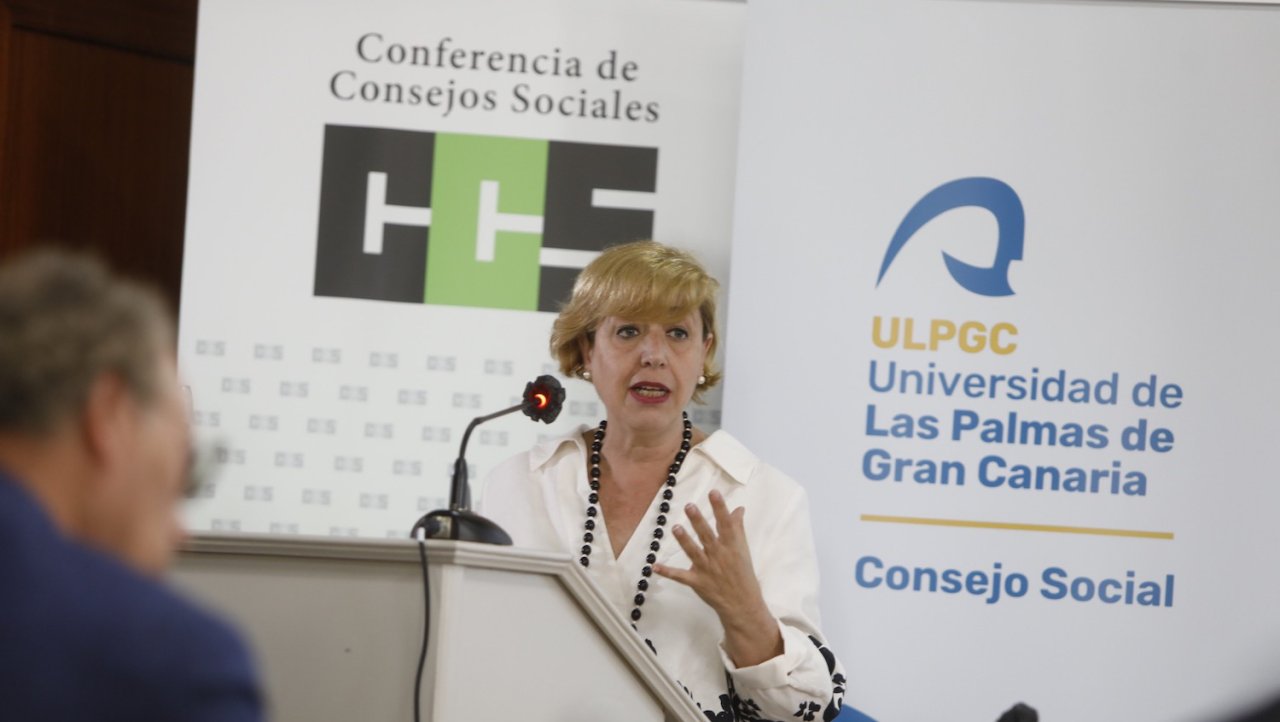
The operational technical director of the Conference of Social Councils of Spanish Universities participated in the Conference on 'Next Generation Funds for the detection of fraud linked to their receipt: an obligation for public universities'
“The Canary Islands and Asturias are the only autonomous communities that have given internal control of the universities to the Social Councils,” declared Pilar Muñoz, operational technical director of the Conference of Social Councils of Spanish Universities, during the presentation of the report “An X-ray of Spanish public universities through the reports of the External Control institutions”. Muñoz said he could not explain why “after so many years since the arrival of the LOU, the rest of the regions have not enacted a regulatory margin.”
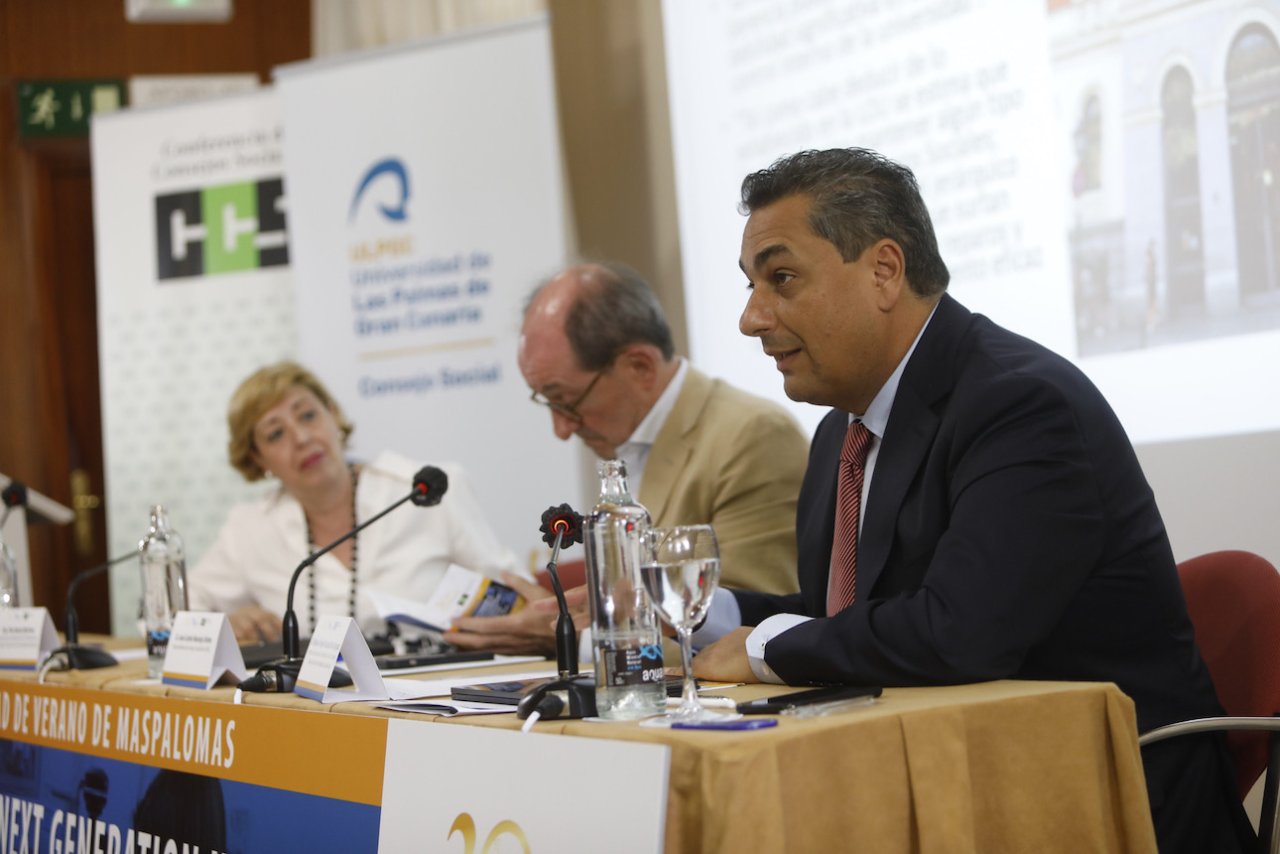
This report was presented at the Conference on 'Next Generation Funds for the detection of fraud linked to their receipt: an obligation for public universities', organized by the association in which he works and the Social Council of the ULPGC, within the program of the XXX Summer University of Maspalomas.
During her speech, Pilar Muñoz commented on the situation of some of the Spanish public universities that had surprised her the most. In the case of the Canary Islands, he said that the years audited by the external control bodies of the Canary Islands have been 2003, 2014 and 2015 and that recently “a new report has been made that will have to be published soon, which is why we have not been able to count on it.” to do this job.”
Regarding the Community of Madrid, Pilar Muñoz confessed that “it is the case that has been the most shocking to us,” she said that “with its six public universities, it is the Community that receives the most budget in this area and yet none have been audited since in 2012”, in total there are “14.402 million euros not audited by any external control body”.
Muñoz detailed the situation of each Madrid university and, as for the University of Alcalá, expressed that "ten years ago it carried out its work in accordance with the annual program of actions and that programming was approved by the Social Council, but it was the manager and depended on the rector”, an “organic and functional dependence on the manager” that also happened at the Autonomous University of Madrid and at the Polytechnic.
On the other hand, Muñoz Martínez stated that “the Carlos III University in 2012 did not have an internal control body, but rather it was dispersed in several administrative units” and that “it also had no action plans, no annual reports of actions, nor reports".
When referring to the budget of the Complutense, he admitted that these are figures "that escape my imagination, we are talking about an initial budget of 4.219 million and a final one of 4.936", regarding this institution he explained that "until 2011, the internal control only consisted of the prior inspection of expenses and income” and “that there were no permanent financial control or internal audit actions, although they are provided for in the regulations.”
On the same matter, Muñoz finally alluded to the Rey Juan Carlos, university in which “at that time, the area of general control and intervention depended organically and functionally on the rector and was endowed with autonomy with respect to the manager.”
In conclusion to the Madrid situation, the technical director said that "in none of the public universities, the service unit in charge of internal control depends on the Social Council as the Court of Accounts has repeatedly recommended", something that also happens "in Andalusia, the autonomous community that has the most universities.”
Muñoz Martínez also presented the latest audit report from the Chamber of Accounts of Aragon, because “I found very curious an allegation that the university makes when the Chamber of Accounts tells it that internal control should in no case depend on the rector.” “It is very interesting because the argument is concise, short and blunt.”
Something similar happens with the Region of Murcia, “a case in which the Autonomous Community and the University make allegations, which is strange to say the least,” said Pilar Muñoz.
Muñoz concluded with some general conclusions such as that "all external control bodies influence the need to adapt the unit to the applicable regulations, establishing its functional dependence on the Social Council", which is why they "reveal the need for regulation by part of the Autonomous Communities” or that “everyone agrees that the majority lack action plans, procedural manuals and annual reports.”
The presentation was also developed by Miguel Ángel Acosta, general secretary of the Conference of Social Councils of Spanish Universities, who addressed the 2003 and 2012 reports made by the Court of Accounts on the situation of the universities saying that “these documents are very useful for the university, because they have a very relevant scope” and that “analyze the economic and financial management related to the preparation, approval and execution of the budget of the academic institution.”
On the other hand, Acosta valued the figure of the social councils, because he assured that they are “an important control body for the university and to improve its inefficiencies and inefficiencies”, as well as that “if economic control depended on the Council Social could dedicate itself to issues to make assessments of the performance of certain services as required by law.”
These sessions, in which more than 50 people from universities and social councils from all over Spain and members of the accounts hearings of several autonomous communities have participated, have provided a space for reflection and dialogue in which different members of the Social Councils They have demanded that the internal control of the universities be managed by the body of which they are a part. Ángel Tristán, president of the Social Council of the ULPGC, defended that Spain must, “on the advice of the European Union and the OECD, make an urgent change in governance whose driving axis is the configuration of a new Main Government Body”, and the importance to “set up a fraud prevention and control system, which Brussels requires of us for the management of the Next Generation post-pandemic funds.”
Antonio Abril, president of the Conference of Social Councils of Spanish Universities, also claimed the figure of social councils and in relation to the LOSU said that "he misses that the document includes the strengthening of the competence of these bodies", since that we have “an anomalous university governance system criticized by all reports.” He added that “LOSU is a missed opportunity, because it does not address the issue of transformation, governance, government management, transparency and accountability of universities.”
Abril addressed the central government saying that “with the draft Law, the dialogue with the Ministry has been frankly frustrating, they have treated us as a paralyzing and annoying body.” He recalled that "in 2013 it was proposed that internal control depend on the social councils and that their presidents be heard in the appointment of members, but the government did not include any of these aspects in the legislation," and listed the four key elements for the good governance of universities: ethics, transparency, accountability and balance of powers. Furthermore, he added that “the social councils must be very proactive and as militant as possible during the development of the law.”