Retaining and attracting new talent to the tourism sector, a key issue in this post-Covid era, was addressed at this year's ITB Berlin trade fair in a special session on the future of work in tourism . It's worth remembering that the pandemic led many tourism and hospitality workers to switch sectors, so much so that there was talk of "the great resignation in tourism."

Work environment, vocation and new narrative
In the ITB area for hotel vocational training schools, Josef Jans , from the Swiss school SHL in Lucerne, briefly pointed out the three key points that we will delve into in this post: (1) A better work environment adapted to the worker, putting each one in the right position; (2) Hospitality and a willingness to serve is an attitude and requires vocation ; (3) Focus on the positive aspects of working in tourism and hospitality; it is an attractive job with a great future.
In this regard, Sybille Reiss , Chief People Officer of the TUI Group, participated in a panel discussion on the future of work and pointed out that "from tourism companies we need a new narrative about the professions we offer" (below I include the example of TUI in the best cases).
I highlight some contributions from another discussion table on personnel:
Prof. Heinz-Dieter Quack : "It's not a problem with the business model itself, because in the hospitality industry we work when others are on vacation; that's our profession. If we have a problem with that, then yes, there is a problem."
Dirk Binding (German Chamber of Commerce): "We need to go into schools and inform students about the real conditions in the industry, what has changed. We also need to make jobs more attractive with more flexible working models."
Otto Lindner (German Hotel Association): "We need to change the negative narrative about the hospitality industry: it is true that we work when others are on vacation, but we also have time off when others are working."
Case Studies
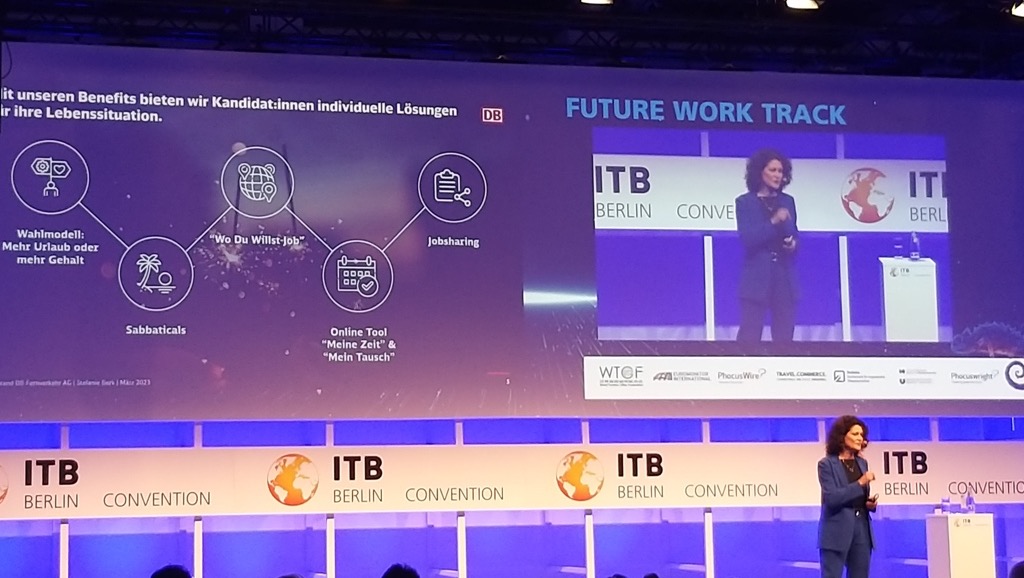
Stephanie Berk, Marketing Director of Deutsche Bahn (the equivalent of Spain's RENFE), presented several tools from their personnel policy. I would particularly highlight the focus on providing individualized solutions for employee situations or lifestyles, as these three examples illustrate:
(1) Choice of " more vacation or more pay " : the worker can increase vacation beyond the stipulated days with additional (unpaid) days.
(2) sabbaticals: The worker can accumulate days over a long period of time for a longer “sabbatical.”
(3) Application "My time & My change": This tool allows the worker to expedite shift changes with colleagues in the event of personal unforeseen events.
This flexibility in human resources policy is also evident in the hiring process, where employees express their preferred daily working hours (meaning the company adapts to individual lifestyles ). Furthermore, the company is also committed to greater inclusion of women in management positions (target: 30% by 2024) and professional development opportunities, as well as ample opportunities for internal advancement.
The Paulinen Hof Hotel is seen in Germany as a model of fair labor practices. Its director, Christian Rex, explained at ITB Berlin how the digitization of various processes (work shift scheduling app, teleworking options, flexible hours, etc.) was one of the key factors that made them more efficient and contributed to the qualitative improvement of jobs. “With digitization, we have been able to free up our staff and gain time for our true purpose: being hosts. The processes to be digitized must be the right ones; not all processes are suitable for digitization.”
In the context of strategies for recruiting young talent, the entertainment platform TikTok , a global leader among young people who also seek employment there, was a major topic of discussion at ITB. Michael Schumacher, from Travel&Mobility/TikTok, outlined some key aspects of communicating with Generation Z and Millennials. “Employers need to adapt to TikTok’s format of short videos and engaging, fun, and authentic content, without resorting to clowning around.”
He gave several examples, of which I highlight a video from the VW company, where one of its car models is seen from behind, the trunk opens and inside is its CEO who greets and welcomes the company. “To build an employer brand on Tik Tok, apart from authentic content, a continuous presence is needed with the transmission of the company culture, so that the user's trust is gained.”
Tour operator initiatives
With the new "Let's TUI it" campaign, the TUI Group launched an initiative to attract staff at a time when, as we've seen, attracting employees is one of the main challenges facing the tourism industry. A key part of the project is creating a new narrative about tourism professions , as TUI's Chief People Officer explained . To this end, the staff has created a fun video showcasing the daily work of various professions within the TUI Group, from the TUI Fly aircraft engineer and destination guides to the data analyst in Hanover.
The video is phenomenal and an example of how a positive image of what it is like to work in the tourism sector can be conveyed to young people, in this case from the point of view of the tour operator. I miss more similar initiatives by hoteliers and hoteliers.