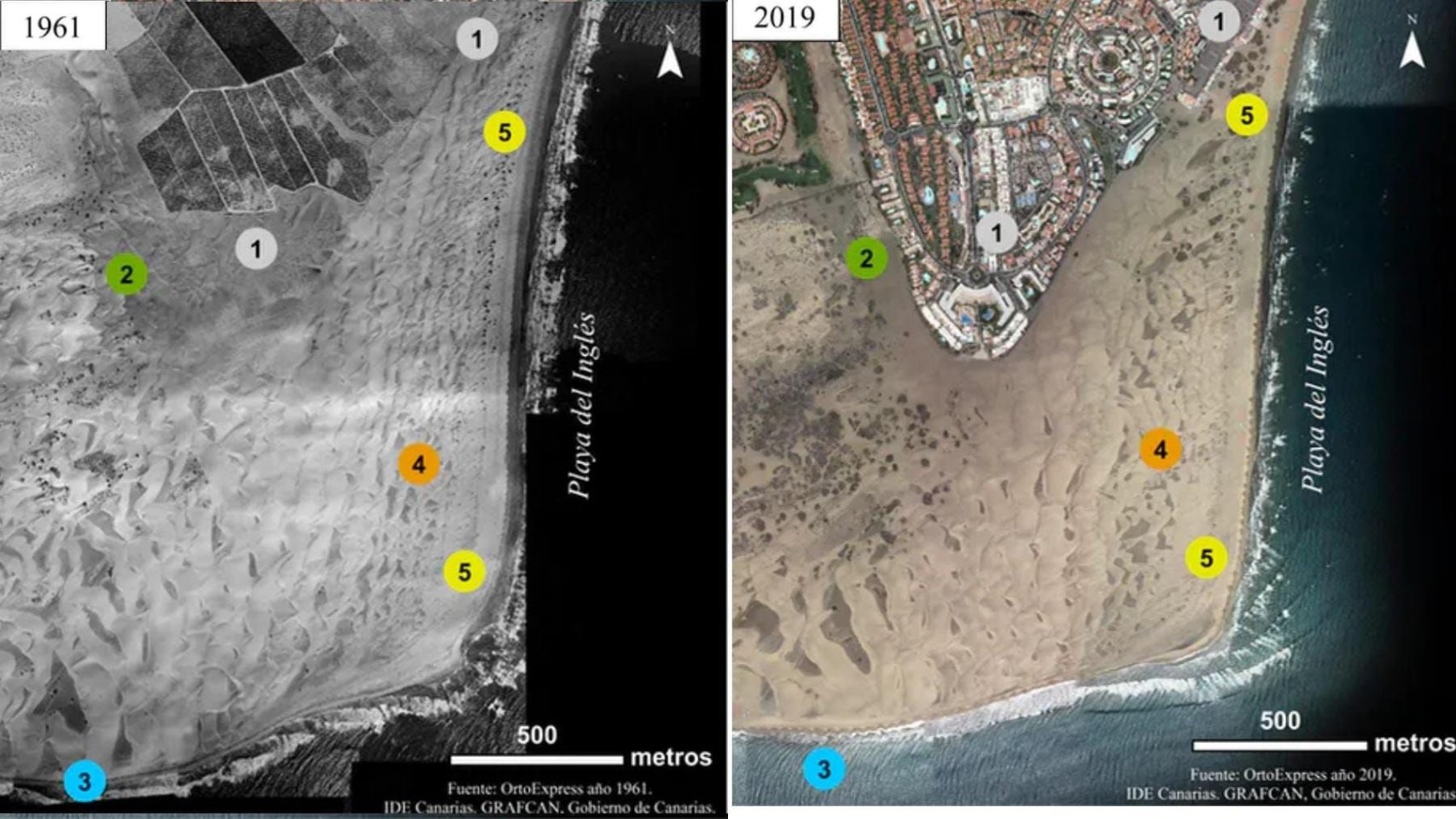
Las Dunas de Maspalomas is what generates the most money in the Canary Islands in terms of value generation and makes San Bartolomé de Tirajana one of the richest municipalities in the EU. The Maspalomas Dunes have been the subject of controversy because some foreigners have reported that the sand invades them, preventing them from enjoying their life in peace. Tourism promoters from Las Palmas took advantage of this emblematic surface to the detriment of employment in the labor market in the south of Gran Canaria. Now a good part of these areas are pasture for homes sold on Airbnb and there are people who do not dedicate the properties for what they were configured for but rather to reside permanently, damaging the tourist destination. This was previously tolerated because tourists came, now they are like cheap houses in the Ciudad Jardín neighborhood of Las Palmas but in Maspalomas.
The Maspalomas Dunes have returned with the writings under their arms and this is the responsibility of those who have had power in Las Palmas over the decisions of the south.
Lucía Rodríguez Arvelo, an environmentalist with a master's degree in Protected Natural Spaces, has pointed out that "if we look at the historical orthophotos, we see how half of the urbanization of Playa del Inglés is on the old ecosystem of Maspalomas. So this problem is the inheritance of poor territorial planning, of not understanding how a dune ecosystem works.
For Rodríguez Arbelo "experts maintain that if the mobile dune system is prevented from recovering its natural behavior, that idyllic image of Maspalomas will be just a photo to remember in 50 years." The problem lies mainly in the fact that in the Canary Islands a territorial plan has not been drawn up that respects natural spaces, the DPMT boundaries are not respected and those who have influence and money want to live right on the coast without having consequences. That is to say: the problem is not the Dunes, it is bad urban planning practices.